Exam Strategy, Timing, and Full Practice Exam
This is it — Day 21. You have spent the last 20 days building a comprehensive understanding of AI concepts, AI system security, AI-assisted security operations, and AI governance. Today we shift from learning content to mastering the exam itself. Knowing the material is necessary but not sufficient — you also need to know how the CY0-001 exam works, how to manage your time, how to approach performance-based questions, and how to avoid common traps. After covering exam strategy, you will work through a 15-question mini practice exam that covers all four domains with realistic weighting.
Exam Logistics — What to Expect
The CompTIA SecAI+ (CY0-001) exam is delivered through Pearson VUE testing centers or via OnVUE online proctoring from your home or office. Both options are available when you schedule your exam through the CompTIA or Pearson VUE website.
Testing center exams require you to arrive at least 15 minutes early. You will present two forms of valid identification — typically a government-issued photo ID (driver's license or passport) and a secondary ID with your name (credit card, employee badge). You will store personal belongings in a locker and will not be allowed to bring notes, phones, watches, or other electronic devices into the testing room. The testing center provides a whiteboard or erasable notepad for scratch work.
OnVUE online exams require a stable internet connection, a webcam, a microphone, and a private room where you will not be interrupted. Before the exam begins, you will take photos of your ID and your testing environment. The proctor monitors you via webcam throughout the exam. Your desk must be clear of all materials except your computer. No secondary monitors, no reference materials, and no other people in the room.
The exam contains a maximum of 80 questions and you have 165 minutes to complete it. The passing score is 750 on a scale of 100-900. Question types include multiple choice (single and multiple answer), drag-and-drop, and performance-based questions (PBQs) that present scenario-based simulations.
Retake policy: if you do not pass on your first attempt, you may retake the exam after a waiting period. CompTIA requires a 14-day wait after a failed first attempt. There is no limit on the number of retakes, but each attempt requires purchasing a new exam voucher or having a retake voucher.
Time Management Strategy
With a maximum of 80 questions in 165 minutes, you have roughly 2 minutes per question on average. However, not all questions require equal time. Standard multiple-choice questions should take 60-90 seconds. PBQs and scenario-based questions may take 3-5 minutes or more.
Here is a proven time management strategy. First pass (90-100 minutes): work through all questions at a steady pace. Answer every question you can confidently answer. For questions you are unsure about, make your best guess, flag the question for review, and move on. Do not spend more than 2 minutes on any single question during the first pass. Second pass (40-50 minutes): return to flagged questions. With the pressure of the first pass behind you, you may find that context from other questions helps you answer the ones you were unsure about. Give each flagged question the additional time it needs. Final review (15-20 minutes): if time permits, review your answers. Focus on questions where you changed your answer or were least confident. Check that you have not left any questions unanswered.
PBQ strategy: Performance-based questions typically appear at the beginning of the exam. Many experienced test-takers recommend flagging PBQs and returning to them after completing the multiple-choice questions. This approach has two advantages: it prevents you from spending too much time on a single PBQ and losing time for easier questions, and it allows you to warm up on multiple-choice questions before tackling complex scenarios.
PBQ Strategy and Question Analysis
When you encounter a performance-based question, read the entire scenario before taking any action. PBQs often contain multiple requirements, and starting to solve before understanding the full picture can lead you down the wrong path.
Identify the domain being tested. PBQs are mapped to specific exam objectives. If the scenario describes configuring security controls for an AI pipeline, you are in Domain 2 (Securing AI Systems). If it describes analyzing SIEM alerts generated by an AI system, you are in Domain 3 (AI-Assisted Security). Identifying the domain helps you recall the relevant frameworks, tools, and best practices.
Eliminate confidently. In multiple-choice and multiple-answer questions, start by eliminating answers you know are wrong. Even if you cannot identify the correct answer immediately, reducing the options from four to two dramatically improves your odds. Look for answers that are technically accurate but do not address the specific question being asked — CompTIA loves using these as distractors.
Watch for absolute language. Answers containing words like "always," "never," "guarantees," or "eliminates all risk" are usually wrong. Security is about risk management, not risk elimination. The correct answer almost always acknowledges trade-offs and uses qualified language like "reduces," "mitigates," or "minimizes."
Read every answer choice. Do not stop reading after you find an answer that looks correct. CompTIA often includes a "good" answer and a "best" answer. The question may ask for the "MOST appropriate" or "BEST" course of action — in these cases, multiple answers may be partially correct, but only one is the best answer.
Common Traps and Key Exam Tips
Trap 1: Confusing similar concepts. The exam will test whether you can distinguish between closely related concepts. Know the difference between adversarial evasion (manipulating inputs to fool a model at inference time) and data poisoning (corrupting training data to compromise a model during training). Know the difference between model extraction (stealing a model through queries) and model inversion (inferring training data from model outputs). Know the difference between transparency (disclosing that AI is being used) and explainability (explaining why a specific decision was made).
Trap 2: Scope mismatch. A question may describe a scenario that touches multiple domains. The answer that addresses the specific concern raised in the question is correct, even if other answers address valid but unrelated concerns. If the question asks about governance and an answer addresses a technical security control, that answer is likely wrong — even if the control is a good idea.
Trap 3: Outdated knowledge. The CY0-001 exam reflects current best practices. Answers based on outdated approaches — such as relying solely on perimeter security for AI systems or treating AI governance as optional — are incorrect.
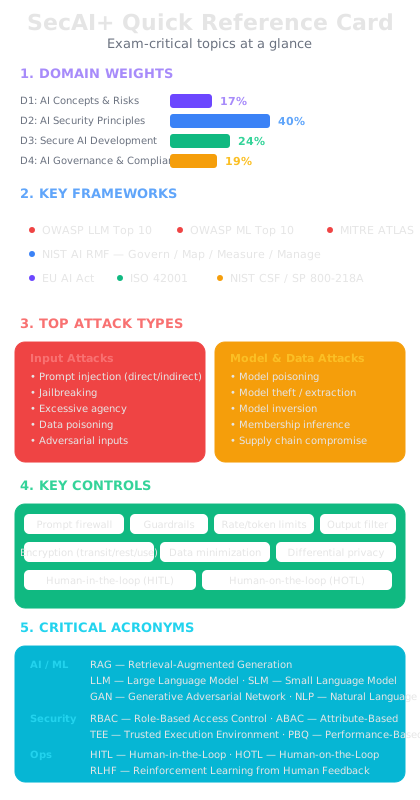
Key tip: Know your acronyms. The exam assumes familiarity with key acronyms: NIST AI RMF (Govern, Map, Measure, Manage), OECD (AI Principles), EU AI Act (risk classifications), ISO 42001 (AIMS), ISO 23894 (AI risk management), CASB (Cloud Access Security Broker), DLP (Data Loss Prevention), SIEM (Security Information and Event Management), SOAR (Security Orchestration, Automation, and Response), RAG (Retrieval-Augmented Generation), RLHF (Reinforcement Learning from Human Feedback), PII (Personally Identifiable Information), and GAN (Generative Adversarial Network).
Key tip: Domain weighting matters. Domain 2 (Securing AI Systems) carries the most weight at 40%. Domain 3 (AI-Assisted Security) is next at 24%. Domain 4 (AI Governance) is 19%, and Domain 1 (AI Concepts) is 17%. If you need to prioritize your remaining study time, focus on Domain 2.
Quick Domain Review
Before the practice exam, let us do a rapid review of the most critical concepts from each domain.
Domain 1 — AI Concepts and Techniques (17%): Understand the AI taxonomy (AI, ML, deep learning, NLP, generative AI). Know the difference between LLMs and SLMs. Understand training methods (supervised, unsupervised, reinforcement, transfer learning, fine-tuning). Know what RAG is and why it matters. Understand prompt engineering, system prompts, and AI pipelines including data ingestion, preprocessing, training, and inference.
Domain 2 — Securing AI Systems (40%): This is the largest domain. Know the AI attack surface: data poisoning, adversarial evasion, model extraction, model inversion, prompt injection (direct and indirect), and supply chain attacks. Understand defenses: input validation, output filtering, guardrails, differential privacy, federated learning, adversarial training, model watermarking, and access controls. Know how to secure AI pipelines end to end — from training data to model serving endpoints. Understand MLSecOps and how it integrates security into the ML lifecycle.
Domain 3 — AI-Assisted Security Operations (24%): Understand how AI enhances SOC operations, threat detection, vulnerability management, and incident response. Know how AI-powered SIEM and SOAR platforms work. Understand UEBA (User and Entity Behavior Analytics) and how AI establishes behavioral baselines. Know the role of AI in threat intelligence, phishing detection, and malware analysis. Understand the limitations — AI-assisted security requires human oversight and is not a replacement for skilled analysts.
Domain 4 — AI Governance, Risk, and Compliance (19%): Know the AI CoE structure, roles (data scientist through AI auditor), and governance frameworks. Understand responsible AI principles (fairness, transparency, explainability, accountability). Know the EU AI Act risk classifications. Know the NIST AI RMF four functions (Govern, Map, Measure, Manage). Understand ISO 42001 and ISO 23894. Know how to handle Shadow AI and the difference between sanctioned and unsanctioned AI tools.
Now it is time for the practice exam. These 15 questions are weighted to approximate the actual exam distribution. Take each question seriously — read all answer choices before selecting your answer.
Practice Exam — Domain 1 Questions
The following three questions cover Domain 1: AI Concepts and Techniques.
Practice Exam — Domain 2 Questions
The following six questions cover Domain 2: Securing AI Systems. This domain carries 40% of the exam weight.
Practice Exam — Domain 3 Questions
The following three questions cover Domain 3: AI-Assisted Security Operations.
Practice Exam — Domain 4 Questions
The following three questions cover Domain 4: AI Governance, Risk, and Compliance.
Interpreting Your Results
If you answered 12 or more questions correctly, you are in strong shape for the exam. Focus your remaining study time on any questions you missed and review the related lesson material.
If you answered 9-11 correctly, you have a good foundation but should review the domains where you missed questions. Pay particular attention to Domain 2, which carries 40% of the exam weight.
If you answered fewer than 9 correctly, consider reviewing the full course material before scheduling your exam. Focus especially on Domains 2 and 3, which together account for 64% of the exam.
Regardless of your score, remember that this is a 15-question sample — the actual exam has up to 80 questions and covers the material in greater depth. Use this practice exam to identify your weak areas, then go back to the relevant lessons for targeted review.
Final advice: schedule your exam within two weeks of completing this course while the material is fresh. Get a good night's sleep before the exam. Arrive early or log in early for online proctoring. Trust your preparation, manage your time, and read every question carefully. You have put in the work — now go earn that certification.