Data Security Fundamentals for AI Systems
AI systems are only as trustworthy as the data they consume. Today's lesson covers CY0-001 Objective 1.2 — the data security fundamentals that underpin every AI deployment. Whether you are securing a training pipeline, a vector database, or a retrieval-augmented generation system, you need to understand how data flows through AI architectures and where that flow creates risk.
This is one of the most heavily tested areas on the exam because data problems cause the majority of real-world AI security incidents. Poisoned training data, leaked embeddings, and tampered retrieval pipelines are not theoretical threats — they are active attack vectors that security teams face today.
Data Processing Requirements
Before any data enters an AI system, it must go through several processing stages. Each stage has security implications that the exam tests directly.
Data cleansing is the process of removing errors, duplicates, and inconsistencies from datasets. From a security perspective, cleansing also means removing malicious inputs that could poison a model. A training set contaminated with adversarial examples will produce a model that behaves unpredictably — and an attacker who can inject data into the cleansing pipeline can influence model behavior without ever touching the model itself.
Data verification confirms that data is accurate, complete, and comes from legitimate sources. Verification checks include format validation, range checks, and cross-referencing against known-good datasets. In AI security, verification is your first line of defense against data poisoning attacks.
Data lineage tracks where data originated and every transformation it underwent. Think of it as a chain of custody for training data. If a model starts producing biased outputs, lineage lets you trace back to the specific data source that introduced the bias.
Data provenance is closely related but focuses specifically on the origin and authenticity of data. While lineage tracks the journey, provenance answers the question: "Can we trust where this data came from?" Provenance verification is critical when using third-party datasets for model training.
Data augmentation creates new training examples by modifying existing ones — rotating images, paraphrasing text, adding noise. While augmentation improves model robustness, it can also amplify existing biases or introduce new vulnerabilities if the augmentation process is compromised.
Structured, Semi-Structured, and Unstructured Data
AI systems consume all three data types, and each creates different security challenges.
Structured data lives in relational databases and spreadsheets — rows, columns, defined schemas. It is the easiest to validate and protect because you know exactly what format to expect. SQL injection defenses, access controls, and encryption are well-established for structured data.
Semi-structured data includes JSON, XML, YAML, and log files. It has some organizational structure but does not conform to a rigid schema. AI systems frequently ingest semi-structured data from APIs and configuration files. The security challenge is that semi-structured data can contain unexpected fields or nested payloads that bypass validation rules.
Unstructured data includes text documents, images, audio, video, and PDFs. This is the majority of data that modern AI systems process, and it is the hardest to secure. You cannot easily scan an image for malicious content the way you can validate a database field. Unstructured data is the primary vector for indirect prompt injection — hiding instructions in documents that an AI system will process.
The exam expects you to understand that unstructured data requires fundamentally different security controls than structured data, and that many organizations underinvest in unstructured data security.
Watermarking AI-Generated Content
Watermarking is a technique for embedding invisible markers in AI-generated content to identify its origin. This serves two security purposes: detecting AI-generated content (is this image real or synthetic?) and protecting intellectual property (was this content generated by our model?).
There are two main approaches. Statistical watermarking subtly biases the model's output distribution — for example, slightly favoring certain word choices in text generation. The bias is invisible to humans but detectable by statistical analysis. Embedded watermarking inserts hidden signals directly into outputs — invisible pixels in images, inaudible tones in audio, or specific character patterns in text.
From a security perspective, watermarking is both a defensive tool and an attack surface. Defenders use it to detect deepfakes and verify content authenticity. Attackers try to strip watermarks to pass off AI-generated content as authentic, or forge watermarks to falsely attribute content.
The exam tests whether you understand that watermarking is a detection control, not a prevention control. It helps you identify AI-generated content after the fact, but it does not stop an attacker from generating malicious content in the first place.
RAG Architecture and Security
Retrieval-Augmented Generation (RAG) is one of the most important architectures for the SecAI+ exam. RAG combines a language model with an external knowledge base to produce more accurate, up-to-date responses.
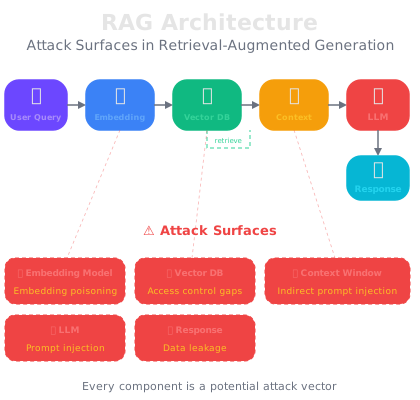
Here is how a RAG system works: A user submits a query. The system converts that query into a vector embedding — a numerical representation of the query's meaning. It then searches a vector database for the most semantically similar documents. Those retrieved documents are injected into the model's prompt as context. The model generates a response based on both its training and the retrieved information.
This architecture creates several security-critical attack surfaces.
The embedding pipeline converts text to vectors. If an attacker can manipulate the embedding model or the vectorization process, they can influence which documents get retrieved for any given query.
The vector database stores embeddings and their associated documents. Unlike a traditional database where you can set row-level permissions, vector databases return results based on semantic similarity — which makes access control fundamentally harder. A query about one topic might retrieve documents from a completely different security domain if their embeddings are similar enough.
The retrieval step is vulnerable to retrieval poisoning. An attacker who can insert documents into the knowledge base can craft content that will be retrieved for specific queries. If those documents contain hidden instructions, the model will follow them — this is indirect prompt injection via RAG.
The context window has a finite size. An attacker who can flood the retrieval pipeline with irrelevant documents can push legitimate context out of the window, degrading response quality or causing the model to miss critical information.
Vector Databases and Embeddings
Vector embeddings are numerical representations of data — text, images, audio — in a high-dimensional space where similar items are close together. When you search a vector database, you are asking: "What stored items are most similar in meaning to my query?"
Security considerations for vector databases include:
Access control complexity. Traditional databases support fine-grained access controls — this user can read this table, this role can update that column. Vector databases return results based on mathematical similarity, making it difficult to enforce the same granularity. If a user's query is semantically similar to a classified document, the database might return it regardless of the user's clearance level.
Embedding inversion attacks. Researchers have demonstrated that it is possible to reconstruct the original text from its embedding, at least partially. This means embeddings are not anonymized data — they can leak sensitive information from the original content.
Poisoned embeddings. If an attacker can modify the embedding model or the embedding process, they can cause specific documents to be retrieved (or not retrieved) for certain queries. This is a subtle but powerful attack that is difficult to detect.
Storage security. Embeddings should be encrypted at rest and in transit, just like any sensitive data. Many organizations treat embeddings as less sensitive than raw text, but given embedding inversion attacks, this is a dangerous assumption.
Data Integrity and the AI Pipeline
Data integrity in AI systems goes beyond traditional checksums and hash verification. You need to ensure integrity at every stage: collection, preprocessing, training, and inference.
Training data integrity means verifying that the dataset has not been tampered with between collection and model training. Hash the entire training dataset and verify the hash before training begins. Any unexpected changes indicate potential data poisoning.
Inference data integrity ensures that user inputs have not been modified in transit. TLS encryption protects against man-in-the-middle attacks, but you also need to validate inputs at the application layer to catch injection attempts.
Output data integrity protects model responses from modification. If an attacker can intercept and alter model outputs before they reach the user, they can inject misinformation or malicious instructions. Output signing — attaching a cryptographic signature to model responses — provides a verification mechanism.
The key exam takeaway: data integrity for AI is not a single control but a continuous chain of verification from data collection through model output. Breaking any link in that chain compromises the entire system.