AI Governance Structures
AI systems are powerful, but without proper governance they become liabilities. Organizations deploying AI need clear structures, documented policies, defined roles, and accountability frameworks to ensure that AI is used safely, ethically, and in alignment with business objectives. This lesson covers the governance structures that the CompTIA SecAI+ exam expects you to understand — from the AI Center of Excellence to the specific roles that make governed AI possible. This maps directly to CY0-001 Objective 4.1.
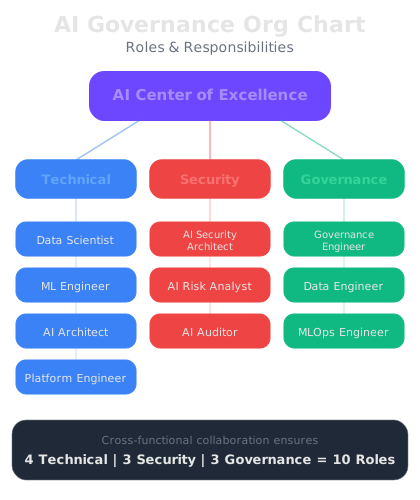
The AI Center of Excellence
An AI Center of Excellence (AI CoE) is a centralized body within an organization responsible for setting the strategic direction, standards, and best practices for AI adoption. Think of it as the governing board that ensures AI projects are aligned with organizational goals and comply with security, legal, and ethical requirements.
The purpose of an AI CoE is threefold. First, it provides strategic oversight — deciding which AI initiatives receive funding, which use cases are appropriate, and how AI fits into the organization's broader technology roadmap. Second, it establishes standardization — creating reusable frameworks, approved toolsets, vetted model libraries, and deployment pipelines that every team must follow. Third, it ensures risk management — evaluating AI projects for potential bias, security vulnerabilities, regulatory exposure, and reputational risk before they reach production.
The structure of an AI CoE varies by organization size, but typically includes representatives from data science, engineering, security, legal, compliance, and business leadership. In larger enterprises, the CoE may have its own dedicated staff and budget. In smaller organizations, it may function as a cross-functional committee that meets regularly. Regardless of size, the CoE must have a clear charter that defines its scope, decision-making authority, and escalation procedures.
The authority of the AI CoE is critical. Without enforcement power, governance becomes advisory at best and ignored at worst. The CoE should have the authority to approve or reject AI projects, mandate security reviews before deployment, require ongoing monitoring of production models, and halt systems that violate policy. This authority must be backed by executive sponsorship — typically from a Chief AI Officer (CAIO), Chief Technology Officer (CTO), or Chief Information Security Officer (CISO).
AI Policies and Procedures
Governance structures are only effective when backed by documented policies. AI policies provide the rules; procedures provide the step-by-step instructions for following those rules.
AI policies should cover several critical areas. An acceptable use policy defines what AI can and cannot be used for within the organization. This includes approved use cases, prohibited applications such as fully autonomous decision-making in high-stakes scenarios without human oversight, and restrictions on data types that may be fed into AI systems. A model lifecycle policy documents requirements for each phase of a model's life — from initial development and testing through deployment, monitoring, retraining, and eventual retirement. This ensures no model runs in production without proper validation and no retired model continues to influence decisions.
A data governance policy for AI specifies what data sources are approved for training and inference, how data must be anonymized or pseudonymized, retention periods for training data, and procedures for handling data subject access requests when personal data has been used in model training. An incident response policy for AI extends the organization's existing incident response plan to cover AI-specific scenarios: model compromise, adversarial attacks, data poisoning discovery, unexpected model behavior, and bias detection in production outputs.
Procedures translate these policies into actionable steps. For example, a model deployment procedure might require code review by a senior ML engineer, bias testing against approved benchmarks, security scanning of the model artifact and its dependencies, approval from the AI CoE, and a staged rollout with automated rollback triggers. Every procedure should specify who is responsible, what tools are used, what documentation is produced, and what approvals are required.
A model card is a standardized document that accompanies every production model. It records the model's purpose, training data characteristics, known limitations, performance benchmarks, fairness metrics, and the responsible parties. Model cards are a governance best practice and an increasingly common regulatory requirement. They provide auditors, security teams, and business stakeholders with a clear understanding of what a model does and does not do.
AI-Related Roles — Data and Engineering
Governed AI organizations require specialized roles. The SecAI+ exam expects you to know these roles, their responsibilities, and how they interact. Let us start with the data and engineering side.
The Data Scientist is responsible for exploring data, building models, selecting algorithms, and evaluating model performance. Data scientists translate business problems into machine learning solutions. They work closely with domain experts to understand requirements and with data engineers to access clean, reliable datasets. From a governance perspective, data scientists must document their modeling decisions, justify algorithm choices, and ensure their models meet fairness and performance standards set by the CoE.
The AI Architect designs the overall AI system architecture. This includes selecting the infrastructure — cloud, on-premises, or hybrid — designing data pipelines, choosing model serving frameworks, and ensuring the architecture supports scalability, reliability, and security. AI architects must consider governance requirements during the design phase, building in logging, monitoring, access controls, and audit trails from the start rather than bolting them on later.
The ML Engineer bridges the gap between data science and production engineering. ML engineers take models built by data scientists and operationalize them — building training pipelines, creating feature stores, optimizing model performance, containerizing models for deployment, and integrating models into applications. They are responsible for ensuring that models run reliably and efficiently in production environments.
The Platform Engineer builds and maintains the underlying infrastructure that supports AI workloads. This includes managing Kubernetes clusters, GPU resources, storage systems, networking configurations, and CI/CD pipelines. Platform engineers ensure that the AI platform meets performance, availability, and security requirements. They work closely with security teams to harden the infrastructure and with ML engineers to optimize resource utilization.
The Data Engineer builds and maintains the data pipelines that feed AI systems. Data engineers are responsible for data ingestion, transformation, quality validation, and storage. They ensure that data flows reliably from source systems into feature stores and training datasets. From a governance standpoint, data engineers implement data lineage tracking, access controls on sensitive datasets, and data quality monitoring that alerts when input data drifts from expected distributions.
AI-Related Roles — Security, Governance, and Operations
The second set of roles focuses on keeping AI systems secure, compliant, and well-governed.
The MLOps Engineer specializes in the operational aspects of machine learning systems. MLOps engineers build and manage the end-to-end ML lifecycle — automating model training, testing, deployment, monitoring, and retraining. They implement model versioning, experiment tracking, A/B testing frameworks, and automated rollback mechanisms. MLOps engineers are critical to governance because they enforce the operational procedures that keep models running safely and consistently.
The AI Security Architect is a specialized security role focused on the unique threats facing AI systems. This role designs security controls for the entire AI stack — from training data protection to model access controls to inference endpoint security. AI security architects assess threats like adversarial attacks, model extraction, data poisoning, and prompt injection, then design defenses against them. They work with the broader security team to integrate AI security into the organization's overall security architecture and ensure AI-specific risks are captured in the risk register.
The Governance Engineer builds the technical systems that enforce governance policies. This includes automated compliance checking, policy-as-code frameworks, audit logging systems, and dashboards that give leadership visibility into AI operations. Governance engineers translate the CoE's policies into automated guardrails — for example, a system that automatically blocks model deployments that fail bias testing or that lack required documentation.
The AI Risk Analyst evaluates and quantifies the risks associated with AI systems. This role conducts risk assessments for new AI projects, monitors risk indicators for production systems, and reports risk posture to leadership. AI risk analysts must understand both technical risks such as model failure and adversarial vulnerability and business risks such as regulatory exposure and reputational damage. They maintain the AI risk register and work with the CoE to prioritize risk mitigation efforts.
The AI Auditor provides independent assurance that AI systems comply with policies, regulations, and ethical standards. AI auditors examine model documentation, review training data practices, test model outputs for bias, verify that security controls are functioning, and assess whether governance procedures are being followed. Audits may be internal or performed by external parties. The AI auditor's findings feed back into the governance process, driving continuous improvement.
How Roles Interact in a Governed Organization
These roles do not operate in isolation. In a well-governed AI organization, they form an interconnected ecosystem. A typical AI project flows through multiple roles in sequence and in parallel.
A project begins when a business stakeholder identifies an AI use case. The AI Architect designs the solution, working with the AI Risk Analyst to assess risks early. The Data Engineer prepares the data pipelines, implementing access controls and lineage tracking. The Data Scientist builds and evaluates models, documenting decisions for the AI Auditor. The ML Engineer operationalizes the model, and the MLOps Engineer builds the automated pipeline around it. The AI Security Architect reviews the entire system for vulnerabilities. The Governance Engineer ensures automated policy checks are in place. The Platform Engineer provisions and secures the infrastructure. Finally, the AI CoE reviews and approves the deployment.
In production, the MLOps Engineer monitors model performance, the AI Security Architect monitors for adversarial activity, the AI Risk Analyst tracks risk indicators, and the AI Auditor periodically reviews compliance. If issues arise, the governance framework provides clear escalation paths and remediation procedures.
The key takeaway for the exam is that governance is not a single person's job — it is a shared responsibility distributed across specialized roles, coordinated by the AI CoE, and enforced through documented policies and automated controls.
Building Governance Frameworks That Connect Security, Legal, and Business
Effective AI governance requires collaboration across three domains that traditionally operate in silos: security, legal, and business.
Security brings threat modeling, vulnerability assessment, incident response, and technical controls. Security teams ensure AI systems are protected against attacks and that sensitive data is handled appropriately. Legal brings regulatory expertise, contract review, intellectual property protection, and liability assessment. Legal teams ensure AI deployments comply with applicable laws and that the organization's rights and obligations are clearly defined. Business brings strategic direction, resource allocation, and stakeholder management. Business leaders ensure AI investments deliver value and align with organizational objectives.
A governance framework must connect these three domains through shared processes and communication channels. For example, a model deployment review should include a security assessment covering technical vulnerabilities, a legal review covering regulatory compliance and IP issues, and a business review covering strategic alignment and risk tolerance. The AI CoE serves as the integrating body, bringing these perspectives together and making balanced decisions.
The framework should also include escalation procedures that cross domain boundaries. If a security team discovers a model vulnerability, there must be a clear path to involve legal if regulatory notification is required and business if the model must be taken offline. Similarly, if legal identifies a new regulatory requirement, there must be a process to translate that into security controls and business decisions.
Documentation is the glue that holds the framework together. Every decision, assessment, approval, and exception should be documented and traceable. This documentation serves multiple purposes: it demonstrates compliance to regulators, provides evidence for auditors, enables post-incident analysis, and creates institutional knowledge that persists as team members change.
For the exam, remember that governance is not a one-time setup — it is an ongoing process that must adapt as the organization's AI maturity grows, as new regulations emerge, and as the threat landscape evolves. The best governance frameworks are living systems that improve through regular review and feedback.