How AI Enables and Enhances Attack Vectors
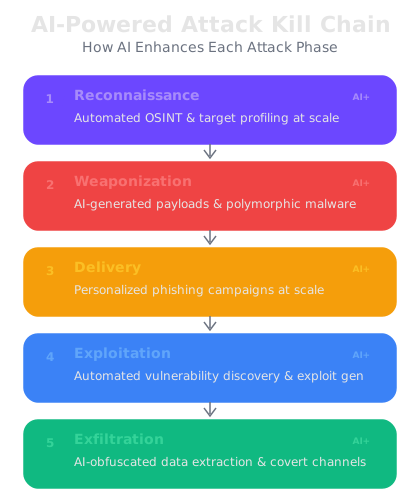
Yesterday you learned how defenders use AI as a security tool. Today the perspective flips entirely. Attackers have access to the same AI capabilities — and they are using them to scale, automate, and enhance every stage of the attack lifecycle. This lesson maps to CY0-001 Objective 3.2 and covers how AI enables threats that were previously impractical: personalized phishing at scale, synthetic media for impersonation, automated reconnaissance, intelligent evasion, and autonomous attack generation. Understanding the attacker's AI toolkit is essential not only for the exam but for building defenses that account for AI-augmented threats. Every detection strategy you design must now consider that the adversary may be using AI to craft attacks specifically engineered to bypass your controls.
Deepfakes — Impersonation, Misinformation, and Disinformation
Deepfakes are AI-generated synthetic media — video, audio, or images — that convincingly depict people saying or doing things they never actually said or did. Deepfake technology is built primarily on Generative Adversarial Networks (GANs) and autoencoders, which learn to map one person's facial features, voice patterns, or mannerisms onto another person's likeness.
The security implications of deepfakes fall into three categories. Impersonation uses deepfakes to pose as a specific individual — a CEO authorizing a wire transfer via video call, a system administrator requesting a password reset via voice call, or a trusted colleague sending a video message. In 2024, a finance worker at a multinational firm transferred $25 million after attending a video conference where every other participant was a deepfake. This attack succeeded because the worker trusted the visual evidence of the video call over procedural controls.
Misinformation is false information spread without deliberate intent to deceive — someone sharing a deepfake video they genuinely believe is real. Disinformation is false information spread deliberately to deceive, manipulate, or cause harm. AI dramatically lowers the cost and increases the quality of disinformation campaigns. A single operator can now generate thousands of realistic but fabricated news segments, social media posts with synthetic images, and audio clips of public figures — content that previously required large teams and significant resources to produce.
For the exam, understand the distinction between detection and prevention of deepfakes. Detection relies on AI models trained to identify artifacts in synthetic media — inconsistencies in lighting, unnatural blinking patterns, audio-visual synchronization mismatches, and spectral analysis of audio. Prevention relies on procedural controls — multi-factor verification for high-value transactions, out-of-band confirmation for unusual requests, and organizational policies that never authorize critical actions based solely on video or audio communication. The exam favors answers that combine technical detection with procedural controls.
Adversarial Networks in Attack Generation
Beyond creating deepfakes, adversarial networks and generative AI models are being weaponized across the attack lifecycle. Attackers use GANs and other generative models to create attack tools and content that are specifically designed to evade defensive AI systems.
Adversarial example generation uses AI to create inputs that fool machine learning classifiers. An attacker can use a GAN to generate malware that is functionally identical to known threats but has been modified just enough to evade ML-based detection. The generator network creates malware variants while the discriminator network (trained to mimic the target's detection system) evaluates whether each variant would be caught. Through iterative training, the generator produces malware that reliably evades detection.
This creates an AI arms race between attackers and defenders. Defenders train models to detect threats; attackers train models to evade those detectors; defenders retrain on the new evasion techniques; the cycle continues. The exam tests your understanding that this arms race means no AI-based detection system is permanently effective — continuous retraining and model updates are essential.
Adversarial networks also generate synthetic training data for attack purposes. Attackers can generate thousands of realistic-looking phishing pages, malicious documents, or network traffic patterns and use them to train other AI models for offensive purposes. This synthetic data approach allows attackers to scale their operations without needing to manually craft each attack artifact.
AI-Powered Reconnaissance — Automated OSINT and Target Profiling
Traditional reconnaissance is labor-intensive. An attacker manually searches social media profiles, corporate websites, job postings, public records, and data breach dumps to build a profile of their target. AI transforms this from a hours-long manual process into an automated operation that completes in minutes.
Automated OSINT (Open Source Intelligence) tools powered by AI can crawl and correlate data from hundreds of sources simultaneously. They extract organizational charts from LinkedIn, identify technology stacks from job postings, map network infrastructure from DNS records and certificate transparency logs, and correlate employee information across social media platforms. The AI does not just collect this data — it synthesizes it, identifying relationships, patterns, and potential attack vectors that a human analyst might miss.
Target profiling goes further by building comprehensive dossiers on individuals. AI can analyze a person's writing style from public posts, identify their interests and social connections, determine their role and access level within an organization, and predict their likely behavior patterns. This profiling directly enables the personalized social engineering attacks discussed in the next section.
AI-powered reconnaissance also automates vulnerability correlation. When an attacker identifies that a target organization uses a specific software stack (from job postings or web technology fingerprinting), AI can automatically cross-reference that stack against vulnerability databases, identify unpatched CVEs, and prioritize potential entry points based on exploitability and likely exposure. What once required a skilled human attacker now requires only access to AI tools and a target name.
AI-Enhanced Social Engineering — Personalized Phishing at Scale
Traditional phishing faces a trade-off: generic mass emails reach many people but have low success rates, while carefully crafted spear-phishing emails are highly effective but take significant time to create. AI eliminates this trade-off entirely. With AI, attackers can generate personalized phishing messages for thousands of targets simultaneously, each message tailored to the individual's role, interests, communication style, and current projects.
AI-enhanced social engineering combines the reconnaissance capabilities described above with natural language generation to create messages that are virtually indistinguishable from legitimate communications. An AI system can analyze how a target's manager typically writes emails — their greeting style, sentence structure, common phrases, signature format — and generate a phishing email that perfectly mimics that style. The email might reference a real project the target is working on, mention a colleague by name, and include contextual details that make the message feel authentic.
This capability extends beyond email. AI generates convincing text messages, chat messages, voice messages (using voice cloning), and even video messages. Attackers can impersonate IT support staff, HR representatives, executives, or vendors — all at scale, all personalized, all simultaneously.
The exam distinguishes between AI-enhanced social engineering and other AI attack types. The defining characteristic is the manipulation of human behavior using AI-generated content that is personalized to the target. If the attack involves tricking a person into taking an action, it is social engineering, regardless of the AI technology used to generate the content.
Defenses against AI-enhanced social engineering require a layered approach: security awareness training that specifically addresses AI-generated content, technical controls like email authentication (DMARC, DKIM, SPF), behavioral analysis that flags unusual communication patterns, and procedural controls that require verification for sensitive actions regardless of how legitimate the request appears.
Obfuscation — Using AI to Evade Detection
Attackers have always used obfuscation to evade detection, but AI takes evasion to a new level of sophistication. AI-powered obfuscation uses machine learning to systematically modify malicious code, network traffic, and attack behaviors so they bypass both signature-based and AI-based detection systems.
Polymorphic malware has existed for decades, but AI enables a far more intelligent form of polymorphism. Instead of randomly mutating code, AI-driven polymorphic engines analyze the target's detection capabilities and generate mutations specifically designed to evade them. The malware can rewrite its own code with each execution, change its network communication patterns, alter its file system behavior, and modify its memory footprint — all while maintaining its malicious functionality.
Traffic obfuscation uses AI to make malicious network communications blend in with normal traffic. AI models trained on an organization's legitimate traffic patterns can shape command-and-control (C2) communications to mimic normal HTTPS traffic, DNS queries, or cloud service API calls. This makes it extremely difficult for network detection tools to distinguish between legitimate traffic and C2 communications.
Living-off-the-land (LotL) techniques, where attackers use legitimate system tools (PowerShell, WMI, certificate utilities) for malicious purposes, are enhanced by AI that can determine which legitimate tools are most likely to evade detection in a specific environment. The AI selects tools, commands, and execution patterns that are consistent with the target's normal administrative activities, making behavioral detection far more challenging.
Automated Data Correlation and Attack Generation
Automated data correlation uses AI to connect information from disparate sources — breached credential databases, social media data, corporate filings, network scan results, and dark web intelligence — into comprehensive attack plans. What distinguishes AI-powered correlation from manual analysis is the ability to identify non-obvious relationships across massive datasets. An AI system might connect a leaked password hash from a 2020 breach, a LinkedIn connection between a contractor and a system administrator, and a misconfigured cloud storage bucket to construct a multi-stage attack path that no human would have assembled.
Automated attack generation is the end-to-end use of AI to create attack tools and payloads. AI models can generate custom malware tailored to a specific target environment, create exploit code for known vulnerabilities, craft phishing payloads that embed malicious functionality in seemingly benign documents, design honeypot-evading reconnaissance tools that detect and avoid security traps, and orchestrate DDoS attacks that adapt their traffic patterns in real time to circumvent rate limiting and traffic scrubbing.
AI can also generate adversarial payloads designed to attack other AI systems. These include crafted inputs that cause misclassification in ML-based detection systems, poisoned data designed to corrupt a target's training pipeline, and prompt injection attacks that manipulate AI-powered security tools into ignoring threats or providing false assurances.
The automation of attack generation means that the barrier to entry for sophisticated cyberattacks has dropped dramatically. Attacks that previously required deep technical expertise and significant time investment can now be generated by AI tools available to less-skilled adversaries. This democratization of attack capabilities is one of the most significant security implications of generative AI and a key theme for the SecAI+ exam.