NIST AI Risk Management Framework (AI RMF 1.0)
The NIST AI RMF is a voluntary framework — but it's the most widely referenced AI risk management standard in the US and increasingly globally. The AIGP exam tests your knowledge of its four core functions and how organizations apply them.
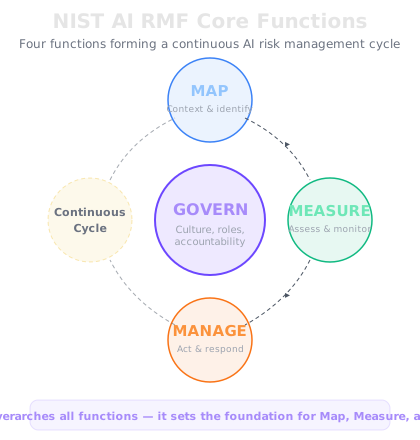
The Four Core Functions
GOVERN — Establish the organizational context, culture, and structures for AI risk management.
- Policies and procedures for AI risk management
- Roles, responsibilities, and accountability
- Organizational risk culture and awareness
- AI risk management integration with enterprise risk management
- Stakeholder engagement and feedback mechanisms
- Diversity, equity, inclusion, and accessibility considerations
MAP — Identify and contextualize AI risks relative to the specific use case.
- Intended use, context, and stakeholders
- Benefits, costs, and risks of the AI system
- Interdependencies and potential cascading effects
- Assumptions, limitations, and potential failure modes
- Risk identification specific to the AI's deployment context
MEASURE — Assess and monitor identified AI risks with appropriate methods.
- Quantitative and qualitative risk metrics
- Fairness and bias metrics
- Performance benchmarks and thresholds
- Third-party testing and evaluation
- Ongoing monitoring against established baselines
MANAGE — Prioritize and act on AI risks based on assessment results.
- Risk treatment: mitigate, transfer, accept, or avoid
- Resource allocation for risk management activities
- Incident response and escalation
- Communication of risk status to stakeholders
- Continuous improvement of risk management
Key Characteristics of the AI RMF
Voluntary — Unlike the EU AI Act, the NIST AI RMF is not legally binding. However, it's increasingly referenced in procurement requirements, industry standards, and as a compliance framework.
Risk-based — The framework is proportionate — organizations apply it based on the level of risk their AI systems pose.
Technology-neutral — Applies to all types of AI systems, not specific technologies.
Lifecycle-oriented — Covers AI risks from design through deployment and retirement.
Iterative — The four functions are meant to be applied continuously, not as a one-time assessment.
Compatible — Designed to work alongside other frameworks (ISO 42001, EU AI Act, sector-specific regulations).
AI RMF Profiles
Organizations can create AI RMF profiles to customize the framework for their specific needs:
Current Profile — Describes the current state of AI risk management practices.
Target Profile — Describes the desired future state.
Gap Analysis — Comparing current vs. target profiles identifies gaps and priorities for improvement.
Profiles can be created for:
- Specific AI use cases (e.g., AI in healthcare vs. AI in marketing)
- Organizational maturity levels (e.g., early-stage vs. mature AI programs)
- Sector-specific requirements (e.g., financial services AI profile)
NIST AI RMF Playbook
The AI RMF Playbook provides practical guidance for each function:
- Suggested actions for implementing each subcategory
- Transparency notes about what information to document
- References to relevant standards and resources
The Playbook is not prescriptive — it offers suggested actions that organizations adapt to their context. This is consistent with NIST's approach across all its frameworks (including the Cybersecurity Framework).
Real-World Scenario
In 2023, the US Department of Commerce's National Telecommunications and Information Administration (NTIA) issued a request for comment on AI accountability, explicitly referencing the NIST AI RMF as the foundational framework for AI risk management in the US. Several major financial institutions, including JPMorgan Chase and Capital One, publicly adopted the NIST AI RMF to structure their internal AI governance programs. JPMorgan's approach mapped the four core functions to their existing enterprise risk management: Govern aligned with their model risk management policies, Map was integrated into their use-case approval process, Measure connected to their existing model validation function, and Manage extended their incident response protocols to cover AI-specific failures.
This adoption pattern demonstrates the AI RMF's strength as a voluntary, flexible framework. Because it is technology-neutral and compatible with existing risk management structures, financial institutions could adopt it without rebuilding their governance infrastructure from scratch. The framework's profile mechanism allowed them to create sector-specific implementations — a financial services AI RMF profile that incorporated regulatory requirements from the OCC, Federal Reserve, and CFPB alongside the general NIST guidance.
For the AIGP exam, the financial services adoption of NIST AI RMF illustrates key testable concepts: the value of a voluntary framework that organizations can adapt to their context, the use of profiles for sector-specific customization, and the importance of integrating AI risk management into existing enterprise risk management rather than building a parallel structure.
Go Deeper
Want to see these concepts applied to full case studies? Check out AIGP Scenarios — 10 real-world governance simulations mapped to the AIGP exam domains.