The EU AI Act — Deployer, Importer, and Distributor Obligations
Yesterday we covered provider obligations. Today we shift to the other roles in the AI value chain: deployers, importers, and distributors — plus the critical concept of when a deployer becomes a provider.
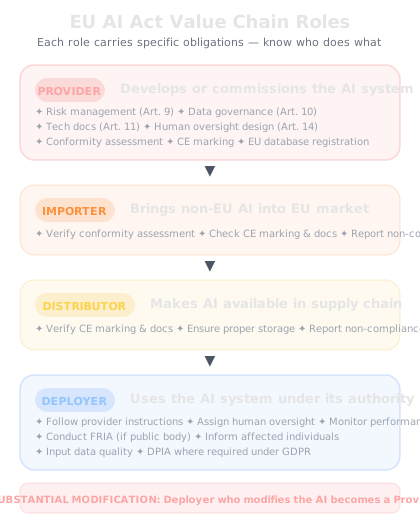
Deployer Obligations (Article 26)
Deployers of high-risk AI systems must:
Use the system properly — Follow the provider's instructions for use. Operate the system within its intended purpose.
Assign human oversight — Ensure individuals assigned to human oversight have the necessary competence, training, and authority.
Monitor performance — Monitor the AI system's operation based on the instructions for use. Report malfunctions and serious incidents to the provider or distributor.
Input data quality — Ensure that input data is relevant and sufficiently representative for the system's intended purpose.
Data protection impact assessment — Conduct a DPIA where required under GDPR Article 35.
Fundamental Rights Impact Assessment (FRIA) — Before deploying a high-risk AI system, deployers that are public bodies (or private entities providing public services) must conduct an assessment of the system's impact on fundamental rights.
Information to affected individuals — When high-risk AI makes decisions about natural persons, inform those individuals that they are subject to AI.
When a Deployer Becomes a Provider
This is a critical exam concept. A deployer becomes a provider when it:
1. Substantially modifies the high-risk AI system (including retraining, fine-tuning with significant changes, modifying intended purpose)
2. Places the system on the market under its own name or trademark
3. Changes the intended purpose of the AI system from what the original provider specified
Why this matters: Organizations that customize off-the-shelf AI products may inadvertently assume provider obligations. Governance frameworks must include a process to assess whether modifications trigger provider status.
Importer and Distributor Obligations
Importers (bring non-EU AI products into the EU market) must:
- Verify the provider has conducted conformity assessment
- Verify CE marking and technical documentation exist
- Ensure the provider can be contacted
- Not place a system on the market if they believe it doesn't comply
- Report non-compliance to the provider and relevant authorities
- Affix their name and contact information to the AI system or its packaging
Distributors (make AI systems available in the supply chain) must:
- Verify CE marking, declaration of conformity, and required documentation
- Not make a system available if they believe it doesn't comply
- Ensure storage and transport conditions don't jeopardize compliance
- Report non-compliance to the provider/importer and authorities
General-Purpose AI (GPAI) Model Provisions
The EU AI Act includes specific obligations for GPAI models (foundation models like GPT-4, Claude, Gemini):
All GPAI model providers must:
- Prepare and maintain technical documentation
- Provide information and documentation to downstream providers integrating the model
- Establish a copyright compliance policy (including compliance with text and data mining opt-outs)
- Publish a sufficiently detailed summary of training data content
GPAI with systemic risk (additional obligations):
- Perform model evaluation including adversarial testing
- Assess and mitigate systemic risks
- Track and report serious incidents
- Ensure adequate cybersecurity protections
- Report energy consumption metrics
A GPAI model is presumed to have systemic risk if its training compute exceeds 10^25 FLOPs or if designated by the European Commission based on other criteria.
Real-World Scenario
In 2024, the Dutch tax authority's childcare benefits scandal (the "Toeslagenaffaire") remained a cautionary tale for AI deployers across Europe. The Dutch government had deployed a self-learning algorithm to flag potentially fraudulent childcare benefit applications. The system disproportionately targeted families with dual nationality, leading to over 26,000 families being falsely accused of fraud. Many were forced to repay tens of thousands of euros, resulting in financial ruin, family separations, and even suicides. The scandal ultimately caused the resignation of the entire Dutch cabinet in January 2021.
From a deployer obligations perspective, this case represents a failure at nearly every level of Article 26. The deploying agency did not conduct a fundamental rights impact assessment, did not ensure meaningful human oversight of the algorithm's fraud flags, did not monitor the system for discriminatory patterns in its outputs, and did not inform affected individuals that algorithmic decision-making was being used. When the system flagged families, civil servants largely rubber-stamped the AI's recommendations without independent review — a textbook case of automation bias compounding algorithmic discrimination.
For the AIGP exam, this scenario illustrates why deployer obligations exist independently from provider obligations. Even if the underlying AI system were technically compliant, the deploying organization's failure to implement proper oversight, conduct impact assessments, and monitor for discriminatory outcomes created catastrophic harm. It also demonstrates when a deployer's modifications and operational choices effectively make it a provider — the tax authority had customized the risk scoring parameters extensively.
Go Deeper
Want to see these concepts applied to full case studies? Check out AIGP Scenarios — 10 real-world governance simulations mapped to the AIGP exam domains.