Documentation — Model Cards, Data Sheets, and AI Impact Assessments
Documentation is the backbone of AI governance accountability. Without it, governance is unverifiable. Today you'll learn the key documentation artifacts and when each is required.
Model Cards
A model card (Mitchell et al., 2019) is a structured document that provides essential information about an AI model to its users and stakeholders.
Standard model card contents:
- Model details — Developer, model type, version, license
- Intended use — Primary and secondary use cases, out-of-scope uses
- Factors — Groups, instrumentation, and environmental factors relevant to the model
- Metrics — Performance measures used and why they were chosen
- Evaluation data — Datasets used for evaluation and their characteristics
- Training data — Overview of training data (more detail may be in datasheets)
- Ethical considerations — Known ethical issues, potential harms, and mitigations
- Limitations and recommendations — Known limitations and guidance for use
Audience: Model cards serve multiple audiences — deployers (how to use the model safely), governance teams (compliance and risk), regulators (oversight), and the public (transparency).
Datasheets for Datasets
Datasheets (Gebru et al., 2021) document the characteristics of datasets used to train and evaluate AI models.
Key sections:
- Motivation — Why was the dataset created? For what task?
- Composition — What data does it contain? Demographics? Class distributions?
- Collection process — How was data collected? By whom? What consent was obtained?
- Preprocessing — What cleaning, filtering, or transformation was applied?
- Uses — Recommended uses and explicit non-recommended uses
- Distribution — How is the dataset shared? Under what license?
- Maintenance — Who maintains it? How are errors reported and corrected?
Datasheets enable governance by making data decisions traceable and auditable.
EU AI Act Annex IV — Technical Documentation
For high-risk AI systems, the EU AI Act's Annex IV specifies mandatory technical documentation contents:
1. General description of the AI system (intended purpose, developer, version)
2. Detailed description of elements and development process
3. Monitoring, functioning, and control information
4. Detailed information on the risk management system
5. Description of changes made during the lifecycle
6. Performance metrics and accuracy levels
7. Detailed description of data governance practices
8. Information on human oversight measures
This is more prescriptive than model cards or datasheets — it's a legal requirement, not a best practice.
Version Control and Documentation Lifecycle
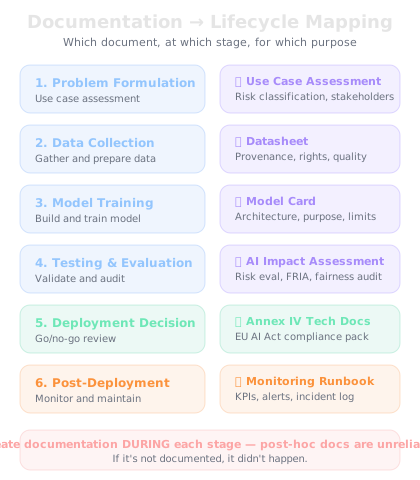
AI documentation is living — it must be updated throughout the system lifecycle:
Version control requirements:
- Every document must have a version number, date, and author
- Changes must be tracked and auditable
- Previous versions must be retained (for regulatory and audit purposes)
- Clear relationship between document versions and model versions
Update triggers:
- Model retraining or significant update
- New test results or fairness metrics
- Change in intended use or deployment context
- Regulatory changes affecting requirements
- Incident or post-incident findings
Common documentation failures:
- Creating documentation only at deployment (missing development-phase decisions)
- Not updating documentation after model changes
- Storing documentation separately from the model (losing traceability)
- Writing documentation for compliance rather than genuine transparency
Real-World Scenario
In 2020, Timnit Gebru and Margaret Mitchell — co-leads of Google's Ethical AI team — published foundational research on model cards and datasheets that became industry standards for AI documentation. Ironically, Google itself faced scrutiny when Gebru was terminated after co-authoring a paper criticizing the lack of adequate documentation for large language models. The paper argued that models like Google's own LaMDA were being developed and deployed without sufficient documentation of their training data composition, environmental costs, or known biases. The incident highlighted the tension between documentation best practices and organizational incentives to ship products quickly.
This case became a landmark moment for AI governance because it demonstrated that even organizations that pioneer documentation frameworks can fail to apply them internally. The EU AI Act's Annex IV requirements were developed partly in response to industry failures like this — mandating that high-risk AI providers produce comprehensive technical documentation before market placement, not as a voluntary best practice. The incident also underscored the importance of organizational independence for governance teams: documentation and risk assessments lose their value if the teams producing them face retaliation for candid findings.
For AIGP exam purposes, this scenario illustrates why documentation must be contemporaneous (created during development, not after), why governance teams need organizational independence, and why regulatory mandates like Annex IV exist — voluntary frameworks alone proved insufficient to ensure consistent documentation practices.
Go Deeper
Want to see these concepts applied to full case studies? Check out AIGP Scenarios — 10 real-world governance simulations mapped to the AIGP exam domains.