Privacy, Ethics, Trust, and Safety Controls
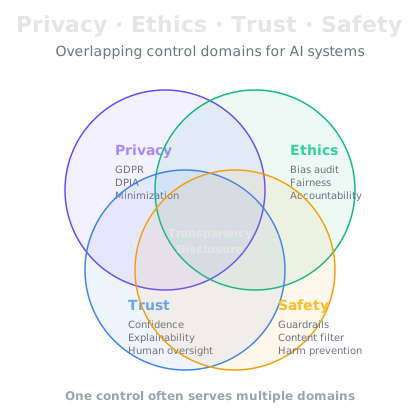
This is one of the most exam-relevant lessons. Privacy, ethics, trust, and safety overlap significantly — controls in one area often serve multiple purposes. Today we cover the specific controls expected for AAISM.
GDPR and privacy controls for AI
GDPR principles apply to AI with specific implications:
Data minimization — Collect and process only the data necessary for the AI system's purpose. Don't train on data "just in case." Every data point in training must be justified by the system's purpose.
Purpose limitation — Data collected for one purpose shouldn't be repurposed for AI training without additional legal basis. Customer support data collected for service delivery needs separate justification for model training.
Data Protection Impact Assessment (DPIA) — Required for AI processing that presents high risk to individuals. Most AI systems that process personal data in decision-making require a DPIA. The assessment must be done before processing begins.
Right to explanation — Under GDPR Article 22, individuals have the right to meaningful information about the logic involved in automated decisions that significantly affect them. This doesn't mean showing model weights — it means explaining the decision factors in understandable terms.
Right to object — Individuals can object to automated processing, including profiling. AI systems must support the ability to exclude individuals from automated processing.
Right to erasure — Deletion requests apply to training data. The question of whether trained models must be retrained is evolving, but organizations should plan for it.
Bias auditing and fairness controls
Bias controls are governance requirements, not just ethical aspirations:
Pre-deployment bias testing — Test models for discriminatory outcomes across protected characteristics before deployment. Use established fairness metrics:
- Demographic parity — Positive outcome rates should be similar across groups
- Equalized odds — True positive and false positive rates should be similar across groups
- Individual fairness — Similar individuals should receive similar outcomes
Post-deployment bias monitoring — Bias can emerge or shift over time as data distributions change. Continuous monitoring with defined thresholds and escalation procedures.
Bias audit documentation — Document what was tested, what metrics were used, what results were found, and what actions were taken. This documentation is essential for regulatory compliance and audit readiness.
Remediation procedures — When bias is detected, what happens? Define the process: investigation, root cause analysis, remediation options (retraining, rebalancing, constraint adjustment), and verification.
The exam expects you to know what bias testing involves and when it's required — not how to perform statistical analysis.
Explainability requirements
Not every AI system needs the same level of explainability. Match requirements to risk:
High-risk decisions (lending, hiring, medical, legal) — Require decision-level explanations. Users and regulators must understand why a specific decision was made for a specific individual.
Medium-risk decisions (recommendations, prioritization) — Require system-level explanations. Users should understand generally how the system works and what factors influence its outputs.
Low-risk decisions (content recommendations, spam filtering) — Minimal explainability required. Basic transparency about AI involvement may be sufficient.
Explainability techniques:
- Feature importance (which inputs most influenced the output)
- Decision trees or rule extraction (approximating model logic)
- Counterfactual explanations ("if X had been different, the decision would have been Y")
- Confidence scores (how certain is the model in its output)
As security manager, ensure the appropriate level of explainability is defined for each AI system and that the technical implementation meets the requirement.
Trust and safety mechanisms
Trust and safety controls ensure AI systems behave reliably and don't cause harm:
Confidence thresholds — Define minimum confidence levels for AI decisions. Below the threshold, the system should flag the decision for human review rather than acting autonomously.
Uncertainty quantification — Models should indicate when they are uncertain. A model that gives a wrong answer with high confidence is more dangerous than one that says "I'm not sure."
Human oversight triggers — Define conditions that require human intervention: low confidence, edge cases, high-stakes decisions, novel inputs, and contradictory signals.
Content filtering for generative AI — Implement input guardrails (block harmful prompts) and output guardrails (filter harmful, biased, or inappropriate content). Both are necessary — input filtering prevents misuse, output filtering catches failures.
Guardrails for generative AI — System-level constraints on model behavior: topic restrictions, response format requirements, factuality checks, and source attribution. Guardrails are policy enforcement mechanisms built into the AI system.
Transparency and disclosure
Transparency obligations vary by use case and jurisdiction:
AI interaction disclosure — Users must know when they're interacting with AI. The EU AI Act requires disclosure for chatbots and emotion recognition systems. Best practice regardless of regulation.
Decision disclosure — When AI makes or influences consequential decisions, affected parties should know AI was involved and understand how to contest the decision.
Deepfake and synthetic content disclosure — AI-generated content must be labeled. This includes synthetic images, video, audio, and text that could be mistaken for human-created content.
Risk disclosure — For high-risk AI systems, disclose known limitations, potential failure modes, and the scope of human oversight.
Transparency requirements should be documented in your AI policies and verified during compliance audits.